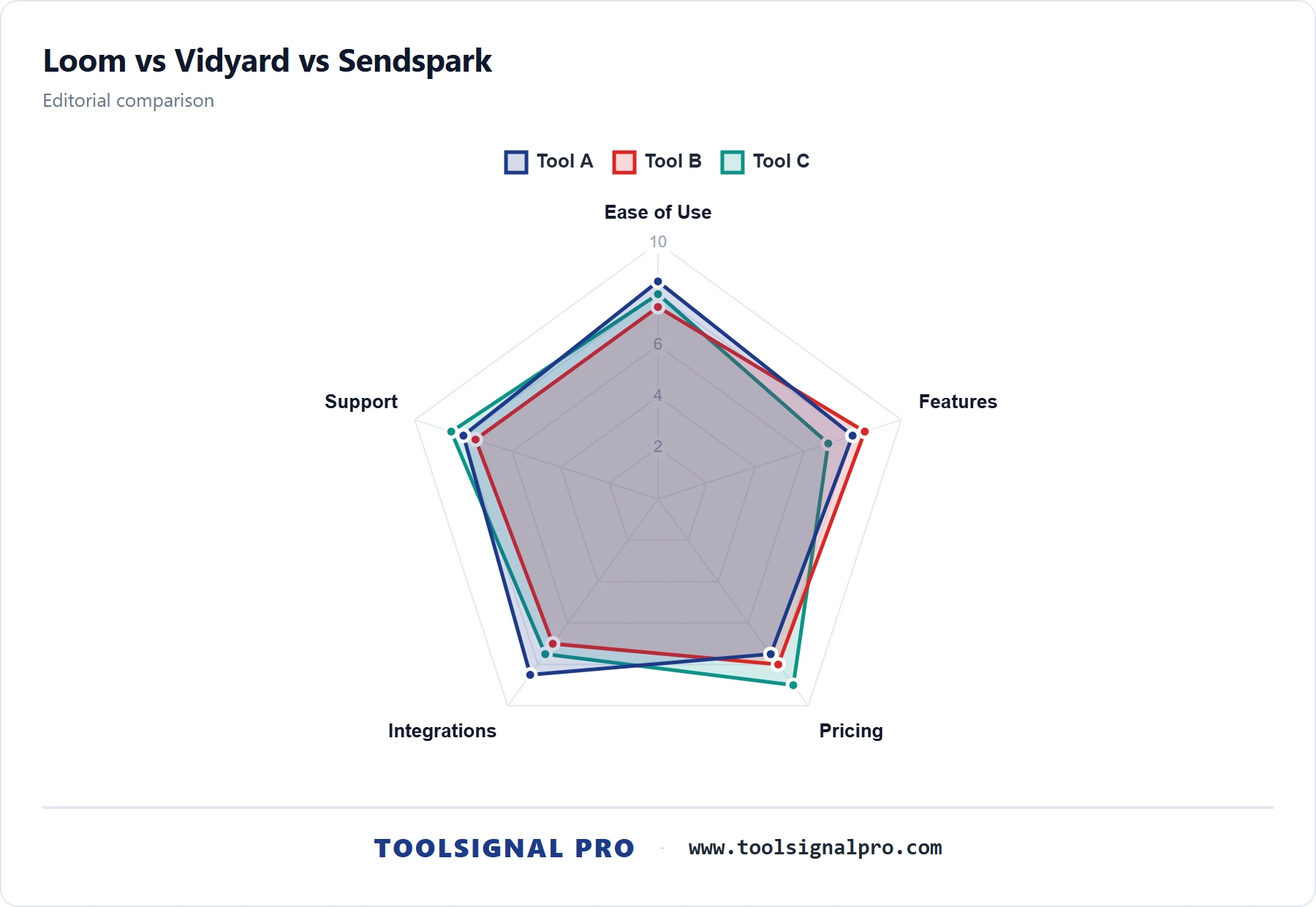
Loom vs Vidyard vs Sendspark compared for sales outreach: pricing, analytics, CRM integrations, and which async video tool fits your small sales team in 2026.
Why Async Video Selling Matters for Small Sales Teams in 2026
Cold email reply rates hover around 1–3% for most small sales teams. Personalized video prospecting consistently doubles or triples that number. For solo founders and lean teams without the budget for a full BDR squad, async video is the highest-leverage play available right now — one rep recording a 60-second personalized walkthrough outperforms ten templated emails. As of May 2026, the three dominant tools in this space are Loom, Vidyard, and Sendspark, each built for a different slice of the async video workflow. The question isn't whether to add video to outreach — it's which platform gives your small team the best return per dollar and per minute spent recording.
Quick Comparison Table: Loom vs Vidyard vs Sendspark
- Loom — Free plan: 25 videos, 5 min each. Paid: Business at $15/user/mo. Best for: general async communication with light sales use. CRM integrations: Salesforce, HubSpot via Zapier or native. Analytics: basic (views, watch %). AI features: auto-summaries, chapters, filler-word removal. Key differentiator: massive adoption, dead-simple UX.
- Vidyard — Free plan: unlimited videos, limited analytics. Paid: Pro at $29/user/mo, Plus at $89/user/mo. Best for: sales teams needing deep CRM integration and viewer intent data. CRM integrations: native HubSpot, Salesforce, Outreach, SalesLoft. Analytics: heatmaps, viewer-level engagement, real-time alerts. AI features: AI script assistant, smart CTAs. Key differentiator: deepest sales analytics and CRM auto-logging.
- Sendspark — Free plan: 30 videos. Paid: Starter at $15/user/mo, Growth at $39/user/mo. Best for: dedicated video prospecting at scale with personalized landing pages. CRM integrations: HubSpot, Salesforce, Outreach native. Analytics: per-recipient watch data, intent signals. AI features: dynamic personalization (name/company on video thumbnails and landing pages), bulk video personalization from CSV. Key differentiator: built specifically for outbound sales personalization at scale.
Feature Deep Dive: Recording, Analytics, and CRM Workflows
Recording experience matters when reps are sending 20+ videos a day. Loom remains the smoothest screen-plus-webcam recorder — it loads fast, works reliably in Chrome, and the desktop app is polished. Vidyard's recorder has closed the gap significantly and now includes an inline teleprompter, which is a genuine time-saver for reps who want to stay on-script. Sendspark's recorder is functional but slightly less refined; its real power is post-recording, where you can dynamically swap in prospect names and company logos across thumbnails and landing pages without re-recording.

Analytics depth is where these tools diverge sharply. Loom gives you view counts and aggregate watch-through percentages — enough to know if someone opened your video, not enough to prioritize follow-ups. Vidyard provides viewer-level heatmaps on the Plus tier and above, real-time "someone is watching" alerts, and engagement scoring that feeds directly into Salesforce or HubSpot contact records. Sendspark sits in the middle: per-recipient watch data and intent signals are available on the Growth plan, but heatmap-level granularity is thinner than Vidyard's.
CRM auto-logging is critical for lean teams that can't afford manual data entry. Vidyard's native Salesforce and HubSpot integrations automatically log video sends, views, and engagement as activities on contact records — no Zapier required. Sendspark offers native CRM logging on its Growth tier, and its Outreach integration embeds personalized videos directly into sequences. Loom's CRM story is weaker: you can push data via Zapier or use the native Salesforce integration, but the auto-logging is less granular than either competitor.

Pricing Breakdown: Which Tool Fits a Small Business Budget?
For a solo founder or team of one, Loom Business at $15/mo and Sendspark Starter at $15/mo are priced identically. But Sendspark Starter includes personalized landing pages and basic recipient-level analytics — features Loom reserves for its higher-tier Business+AI or custom-quoted plans. Vidyard's free plan is generous for recording volume but locks analytics behind the $59/mo Pro plan.
For a team of five reps, the math shifts. Loom Business is $12.50/seat/mo billed annually — for a five-person team that's $75/mo total. Sendspark Growth (the tier with bulk personalization and full analytics) costs $79/mo (annual billing; $99/mo monthly). Vidyard Plus — the tier with real-time alerts and advanced CRM logging — is custom quoted, starting around $445/mo for the published Plus tier. That's a meaningful spread. Hidden costs to watch: Vidyard's heatmap analytics require the Plus tier, which is a steep jump from Pro. Sendspark's CSV-based bulk personalization — the feature that makes it special — is Growth-only. Loom's analytics are thin on every plan, so you may end up buying a third-party tracking layer anyway.
- Cheapest path to sales-grade video — Sendspark Starter at $15/user/mo (personalized pages included)
- Cheapest path to deep analytics — Vidyard Pro at $59/user/mo (viewer-level data, but no heatmaps)
- Cheapest path to "good enough" video — Loom Free (25 videos, 5 min limit, basic stats)
Final Verdict: Which Sales Video Tool Should You Pick?
Sendspark is the ToolSignal pick for small-business sales outreach in 2026. Here's the synthesis across every dimension that matters:
Pricing — Sendspark wins. At $15/user/mo on Starter, it matches Loom's price point while including sales-specific features (personalized landing pages, recipient tracking) that Loom reserves for higher tiers. Even the Growth plan at $39/user/mo undercuts Vidyard Plus by more than half for comparable sales analytics.
Technical edge for sales — Sendspark wins. Dynamic video personalization at scale — swapping prospect names and logos onto thumbnails and landing pages via CSV upload — is a feature neither Loom nor Vidyard matches natively. For a five-person team sending 50+ prospecting videos per week, this is the single biggest productivity multiplier available right now.
CRM and integration ecosystem — Vidyard wins. If your sales org runs on Salesforce with Outreach or SalesLoft sequences and your reps live inside those tools, Vidyard's native integrations and auto-logging depth are unmatched. The real-time viewer alerts that push into Slack or CRM dashboards give pipeline-focused teams an edge Sendspark hasn't fully replicated.
Mainstream adoption and ease of use — Loom wins. With the largest installed base and the most polished recording experience, Loom is the path of least resistance for teams where sales video is a secondary use case alongside internal communication, customer onboarding, and team updates.
The decisive call: If you are a small business buying a tool specifically to improve outbound sales response rates, choose Sendspark. It was built for this exact job, the pricing respects small-team budgets, and the bulk personalization feature compounds in value as your outbound volume grows. If you already run a CRM-heavy sales stack on Salesforce and need enterprise-grade viewer analytics flowing into deal records, Vidyard justifies the premium. If you need a general-purpose async video tool that occasionally supports sales outreach, Loom is the safe default — but understand you're choosing convenience over sales-specific capability.
Before you pay, verify one thing: check whether your primary outreach sequencer (Outreach, SalesLoft, HubSpot Sequences, Apollo) has a native integration with your chosen tool. A broken integration means manual copy-paste of video links into every email, which kills the efficiency gain that makes async video worth adopting in the first place. Sendspark's native Outreach and HubSpot integrations cover most small-team stacks. Vidyard covers the broadest sequencer ecosystem. Loom's sequencer integrations remain the thinnest of the three. Match the tool to your existing workflow before committing to an annual plan.
Does Loom integrate with Salesforce better than Vidyard?
Both integrate with Salesforce, but Vidyard's native Salesforce app offers deeper workflow automation—auto-logging calls, auto-linking videos to records, and dynamic content insertion. Loom requires manual linking or Zapier integration for comparable functionality. If your team lives in Salesforce, Vidyard's tighter integration saves 3-5 minutes per video per rep monthly. Loom works fine if you're okay with occasional manual steps. Test both in your Salesforce sandbox before committing.
Can you really replace email with Sendspark video messages?
Sendspark's email widget lets you embed personalized video directly in Gmail/Outlook, so yes—partially. Open rates jump 70-80% versus text emails. However, some prospects still prefer reading; Sendspark is built to augment your existing email outreach, not replace it — but for the cold-outbound use case specifically, that augmentation is what makes it the small-business pick. Loom and Vidyard lack this native email embedding, requiring links instead. If your sale hinges on breaking through inbox noise, Sendspark's email-native design is worth the $79/month premium over Loom's $12.50/month.
Which tool gives you the best ROI for cold outreach sequences?
Sendspark wins here. Its email widget + automatic follow-up sequencing are built for cold cadences. Vidyard's sequences are strong but need manual setup per prospect. Loom has minimal sequence automation—you're copying links manually. For a sales team running 50+ cold outreach sequences weekly, Sendspark saves 5-8 hours/week in setup. Vidyard saves 2-3 hours. If outbound is your revenue engine, Sendspark's automation ROI typically pays for itself in 2-3 weeks.
What happens to your videos if you cancel your subscription?
This matters more than people think. Loom lets you export videos before canceling, keeping access. Vidyard's policy depends on your plan tier—check the fine print. Sendspark videos stay embedded in sent emails for the lifetime of the recipient's inbox — even after you cancel — but if you cancel, the video link expires within Sendspark's retention window (currently 60-90 days). For long-tail durability, host externally. If you're worried about content ownership, Loom is safest. Before signing any annual contract, ask the vendor directly about video retention post-cancellation—it's a legitimate concern.
Is the learning curve worth switching from Loom to Vidyard?
If your team already uses Loom, switching purely for features might not justify 2-3 weeks of onboarding friction. Loom's simplicity is underrated. Vidyard shines if you're running complex sales motions (sequences, team coaching, dynamic templates). Small 2-3 person teams: stick with Loom. 5+ person teams with sequence-heavy workflows: Vidyard's learning curve pays off in 6-8 weeks. Sendspark fits middle ground—slightly steeper than Loom, simpler than Vidyard. Ask: does your growth require new features or just efficiency?
Do you need Vidyard's expensive plans or does Loom suffice?
Vidyard's $75+/month tiers add team coaching, advanced analytics, and custom branding—luxuries for most SMBs. Loom's $12.50/month plan handles 95% of sales video needs: recording, sharing, basic view tracking. Sendspark ($79/month) justifies cost only if email embedding + sequences are core to your process. Audit your team's actual usage first: if nobody's using advanced features, Loom is the smart choice. Upgrade when you hit specific scaling pain points, not preemptively.